
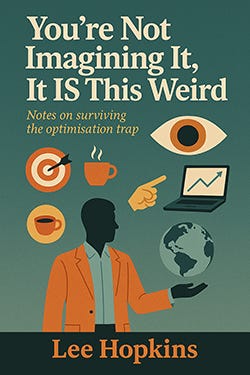
You’re not imagining it, it IS this weird
The Introduction from my somewhat controversial book

If you’ve ever found yourself standing in the supermarket holding a fourteen-dollar loaf of bread that promises to fix your gut, raise your vibration, and possibly solve climate change, while simultaneously checking your phone to see if anyone liked the photo you posted of your morning meditation corner, only to realise you’ve spent more time curating your spiritual practice than actually practicing it—congratulations. You’re living in the twenty-first century, and it’s exactly as bewildering as it seems.
This book isn’t going to tell you to hustle harder, optimise better, eat cleaner, think more positively, or manifest like your rent depends on it. It won’t tell you that your problem is ‘gluten’, or gluten’s shadow twin, ‘dairy’, or your unaligned chakras, or your inner child not being on a high-performance morning schedule designed by wellness influencers who’ve never worked a regular job.
Instead, it’s going to do something far more dangerous. It’s going to invite you to think again.
Not just about food, though we’ll spend considerable time examining how eating became a moral performance requiring constant documentation and expert guidance. About everything. About the strange, shimmering mess of late-stage capitalism, digital distractions, algorithmic intimacy, and deeply confused cultural narratives that tell you to be confident but humble, authentic but filtered, high-performing but gentle, vulnerable but invincible, successful but not too ambitious, spiritual but not religious, healthy but not obsessive about it.
You are being asked to live multiple contradictory lives at once, like an actor in several different plays running simultaneously on the same stage, and the only ‘self-care’ you’re offered for managing this impossible performance is bubble baths and apps that send you notifications reminding you to breathe.
I am not a nutritionist, though I’ll discuss why people have become obsessed with optimising their food intake to levels that would baffle our ancestors. I am not your life coach, though I’ll examine why everyone seems to need professional guidance for activities humans have managed successfully for millennia. I am not a YouTube personality with a slow, comforting voice and a beard made of organic wisdom, though I’ll explore why people seek meaning through carefully curated online experiences.
But I am a human scientist. A trained psychologist and sociologist who studied people before it was monetisable, before every aspect of human behaviour became data for optimisation algorithms or content for engagement platforms.
And I want to take you on a strange little journey through the thicket of modern beliefs—especially the ones that seem helpful but might be harming us in subtle ways that are difficult to recognise when you’re living inside them.
The great acceleration of everything
Something shifted in human culture sometime in the past two decades, like a gear change in the engine of civilisation that most of us felt but few of us fully understood. The pace of change accelerated beyond anything previous generations had experienced, creating a world where last week’s certainties feel historically distant and next week’s possibilities seem both thrilling and terrifying.
Technology promised to make life easier, but somehow made it more complex. We have access to all human knowledge through devices we carry in our pockets, yet we seem more confused about basic questions than people who had to rely on libraries and conversations with their neighbours. We can connect with anyone anywhere in the world instantly, yet loneliness has become a public health crisis requiring government intervention and therapeutic apps.
We’ve optimised convenience to unprecedented levels—food appears at our doors within hours of ordering, entertainment streams endlessly without interruption, and information answers any question before we’ve finished asking it. Yet anxiety, depression, and a general sense that something fundamental is missing from modern life have reached levels that would have alarmed our ancestors, who had genuine reasons to worry about survival on a daily basis.
This isn’t progress anxiety or fear of change—this is the growing recognition that many of the solutions we’ve developed for human problems have created new problems that are more complex and harder to solve than the original difficulties they were meant to address.
We’ve become the first generation of humans to have too many choices about everything—what to eat, how to move our bodies, whom to love, what to believe, how to spend our time, what to optimise next. Choice paralysis has become a genuine psychological condition affecting people who have more options available to them than kings and queens of previous centuries could have imagined.
The monetisation of human experience
Perhaps the most significant shift is how every aspect of human experience has been monetised in ways that would have seemed like science fiction to people living just fifty years ago. Your sleep is tracked and optimised through devices that cost more than some people’s monthly rent. Your relationships are mediated through algorithms designed to keep you engaged with platforms rather than connected with people. Your spiritual development is guided by subscription services that gamify enlightenment like a role-playing game with achievement badges.
This isn’t necessarily malicious—most of the people creating these systems genuinely believe they’re solving problems and improving lives. But the cumulative effect is a world where being human has become a performance requiring constant optimisation, measurement, and improvement according to metrics that may have nothing to do with actual human flourishing.
You can’t just eat food anymore—you have to optimise your nutrition, track your macros, consider the environmental impact, evaluate the ethical implications, and document your choices for social media validation. You can’t just move your body for pleasure—you have to maximise your fitness outcomes, monitor your heart rate variability, and compare your performance to algorithmically generated peers.
You can’t just feel sad when sad things happen—you have to practice emotional regulation, implement coping strategies, and work toward mental health optimisation that treats normal human responses to difficult circumstances as problems requiring intervention.
The monetisation of human experience has created what might be called the ‘optimisation trap’—the belief that every aspect of life can and should be improved through the right combination of products, services, and expert guidance. This trap is particularly insidious because it masquerades as self-improvement while often making people less satisfied with their ordinary human experiences.
The performance of authenticity
One of the most peculiar aspects of contemporary life is how authenticity itself has become a performance requiring careful curation and strategic presentation. Social media platforms reward people for sharing their ‘real’ lives, but only the parts of reality that generate engagement, inspire others, or create envy in carefully calibrated doses.
People document their morning routines not because they enjoy their mornings, but because sharing their routines provides content that positions them as people who have their lives together. They post about their struggles with vulnerability and courage, but only struggles that make them appear relatably human rather than genuinely messy or difficult.
This creates what sociologists call ‘performed authenticity’—the careful presentation of genuine human experiences in ways that serve strategic purposes rather than expressing actual authenticity. The performance becomes so sophisticated that people often lose track of what their actual authentic experiences feel like underneath all the curation and optimisation.
You end up living for the documentation of your life rather than actually living your life, which creates a strange form of alienation from your own experience. You’re always slightly outside yourself, evaluating how your actual experiences will translate into content that represents you appropriately to audiences who are themselves performing their own carefully curated versions of authenticity.
The crisis of simple things
Perhaps the most telling aspect of contemporary confusion is how complicated we’ve made the simple things—eating, sleeping, moving, connecting with others, finding meaning, being present. These basic human activities now require expert guidance, specialised equipment, and ongoing optimisation in ways that would have puzzled every previous generation of humans.
Eating has become so complex that people pay professionals to teach them how to do something their bodies are designed to manage automatically. Sleep requires devices, supplements, and environmental optimisation that transforms bedtime into a ritual more elaborate than religious ceremonies. Exercise has become so specialised that many people are afraid to move their bodies without professional guidance or performance tracking.
This isn’t progress—it’s a form of learned helplessness disguised as sophistication. We’ve convinced ourselves that human activities that worked perfectly well for millions of years now require technological intervention and expert optimisation to be performed safely and effectively.
The crisis of simple things reflects a broader cultural loss of confidence in our own abilities to navigate basic human experiences without external guidance, measurement, and improvement. We’ve become tourists in our own lives, requiring guides and GPS systems for activities that used to be as natural as breathing.
The paradox of infinite information
We live in the first era of human history where all information is instantly accessible, yet we seem to know less about what actually matters than people who had to rely on oral traditions and handwritten books. We can research any topic exhaustively within minutes, but this access to information has somehow made us less wise about fundamental questions of how to live well.
The paradox is that information without context often creates more confusion than clarity. When you can find expert opinions supporting any position on any topic, expertise itself becomes less valuable than the ability to curate information according to your existing preferences and beliefs.
This has created what might be called ‘informed ignorance’—the condition of having access to vast amounts of information while lacking the framework to evaluate what’s actually worth knowing or acting upon. People can recite complex theories about nutrition, psychology, and spirituality while being completely confused about their own basic needs and experiences.
The abundance of information has also created new forms of anxiety about making the ‘right’ choices. When every decision can be researched exhaustively and optimised according to multiple competing frameworks, simple choices become overwhelming projects requiring extensive analysis and comparison shopping.
What this book is and isn’t
This is not a self-help book in any conventional sense. I won’t be providing you with systems, strategies, or step-by-step guides for optimising your existence according to the latest research or expert recommendations. There are already enough books promising to solve your problems through better habits, clearer thinking, or more disciplined execution of proven principles.
This is a book about recognition—recognising the cultural patterns we’re swimming in so unconsciously that we mistake them for natural laws rather than recent inventions that we can choose to participate in or not. It’s about developing what anthropologists call ‘cultural awareness’—the ability to see your own culture as one possibility among many rather than the only reasonable way to organise human experience.
Each chapter tackles one aspect of contemporary confusion through a combination of story, analysis, and gentle mockery of the more absurd aspects of how we’ve chosen to live. Sometimes we’ll explore food culture and why people have developed religious relationships with their dietary choices. Sometimes we’ll examine why dating has become indistinguishable from online shopping with increasingly sophisticated filtering and optimisation systems.
Sometimes we’ll investigate why calm has become a performance requiring expensive equipment and professional guidance. Sometimes we’ll consider why being smart has become strategically disadvantageous in many social situations, or why masculinity and femininity have become complicated performance arts rather than simple expressions of human diversity.
And sometimes we’ll just sit together in the recognition that yes, this is all quite strange, and no, you’re not imagining the weirdness. It really has become this complicated to be a human being in the modern world, and that’s worth acknowledging before we decide what, if anything, to do about it.
An invitation to think differently
The goal isn’t to convince you of any particular worldview or to prescribe solutions for the problems we’ll be examining. The goal is to invite you to think for yourself again, to trust your own experience over expert opinions, to recognise that much of what feels inevitable about contemporary life is actually optional.
You don’t have to optimise everything. You don’t have to document your experiences for social media validation. You don’t have to treat every aspect of being human as a problem requiring solution or improvement. You don’t have to perform authenticity, productivity, wellness, or any other version of successful living according to cultural scripts that may have nothing to do with your actual wellbeing.
This book is for people who are tired of treating their lives like optimisation projects, who suspect that much of what passes for wisdom in contemporary culture is actually sophisticated marketing, and who are ready to trust their own intelligence again rather than outsourcing all judgment to algorithms and experts.
If you’ve ever felt like you’re too sensitive for the contemporary world, too slow for the pace of modern life, too questioning of authorities who speak with great confidence about subjects they may not actually understand—this conversation is for you.
If you’re exhausted by wellness culture but still want to feel well, sceptical of productivity advice but still want to accomplish meaningful things, suspicious of optimisation strategies but still want to live thoughtfully—you’re exactly the kind of person I want to explore these questions with.
The cosmic perspective
Before we dive into the specific confusions of contemporary life, it’s worth remembering that we’re having this conversation on a small planet orbiting an ordinary star in an unremarkable galaxy among billions of galaxies in a universe so vast that our current problems may seem almost charmingly trivial from a cosmic perspective.
This isn’t meant to minimise genuine human struggles or suggest that individual suffering doesn’t matter. It’s meant to provide context that might help us approach contemporary confusion with curiosity rather than panic, humour rather than despair, and the recognition that being human has always been strange—we’ve just developed new and particularly sophisticated ways of making it strange.
Our ancestors worried about being eaten by large animals or starving during harsh winters. We worry about whether our meditation practice is optimal and whether our personal brand authentically represents our values. Both sets of concerns are real within their contexts, but one requires considerably more psychological complexity to maintain.
The universe spent billions of years evolving beings capable of consciousness, creativity, and connection. The least we can do is actually enjoy these capacities rather than turning them into optimisation projects or performance requirements.
This perspective doesn’t solve any practical problems, but it might help us approach our practical problems with the lightness they deserve—recognising that most of what feels urgent about contemporary life is actually quite optional, and that being human is supposed to be more interesting than being productive.
The journey ahead
In the chapters that follow, we’ll explore various aspects of contemporary confusion with curiosity, scepticism, and occasional amazement at the creative ways humans have found to complicate basic aspects of existence.
We’ll examine why food has become a moral category, why calm requires professional management, why dating resembles market research, and why grief has become pathologised rather than honoured. We’ll consider how strategic stupidity has become a social skill, why mystery is being Googled out of existence, and how spirituality has been commodified into lifestyle products.
But we’ll also explore what might be emerging in response to these confusions—the quiet rebellion of people who’ve decided to live authentically rather than optimally, to trust their own experience rather than expert guidance, to find meaning in ordinary experiences rather than constantly seeking extraordinary ones.
This isn’t a journey toward answers so much as toward better questions, toward the kind of thinking that can navigate complexity without being overwhelmed by it, toward approaches to living that are both thoughtful and sustainable.
The goal isn’t to return to some imaginary golden age when life was simpler—it wasn’t, it was just difficult in different ways. The goal is to move forward with wisdom rather than just information, with discernment rather than just options, with authentic engagement rather than optimised performance.
Ready? Let’s begin this strange exploration of contemporary human experience, starting with the peculiar ways we’ve learned to complicate the simple act of eating food, and continuing through various other aspects of modern life that have become unnecessarily complex and surprisingly expensive.
It’s going to be an interesting journey.
Want a free epub version for your phone? Help yourself.
Paperback version (not free)