

What I found when I went looking
Part two of a two‑part essay. Last week I wrote about loss. This week I have a confession.

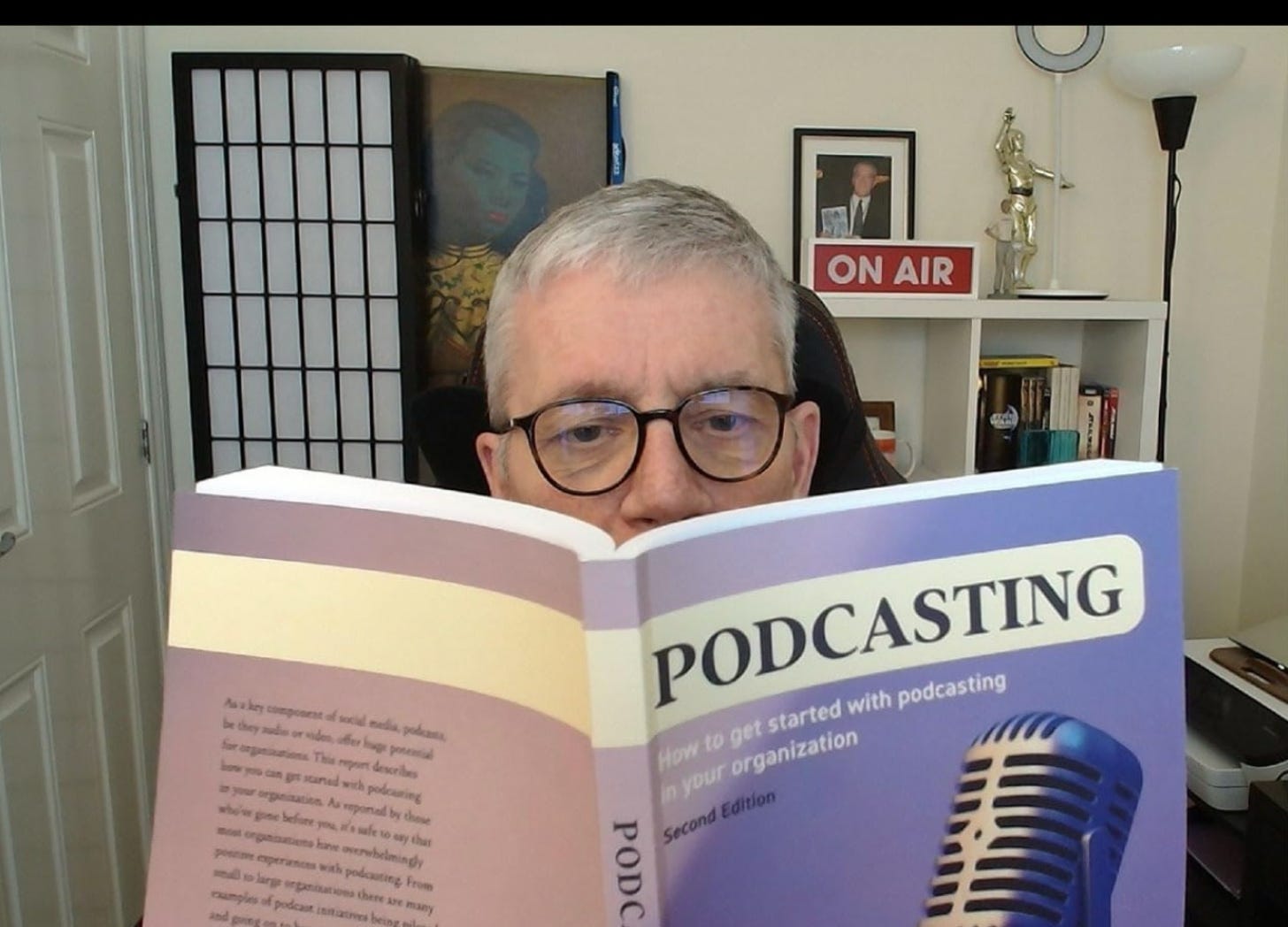
Part two of two. By Lee Hopkins.
Last week I wrote an essay about everything that dissolved. The lineone bulletins from 1998, lost behind a login wall the Internet Archive couldn’t reach. The Better Communication Results podcast from 2005, lost when the Libsyn hosting bill went unpaid. The early FIR correspondent reports, lost when the audio files outlived whatever servers they sat on. The Comms Cafe Chats I made with my dear friend Allan Jenkins, lost when both of those things happened and a third thing besides, which was Allan’s death a few short years later. Thirteen hundred words of dignified melancholy, which is roughly the maximum a Substack reader will tolerate before going to make a cup of tea.
Most of it turns out to have been wrong.
I went looking. I expected to find nothing. What I found, in the end, was nearly everything. Not on any of the servers I had originally trusted. Not in any institutional archive. Not in the Wayback Machine, although the Wayback Machine remembered more of the metadata than I had any right to expect. The recovery happened, of all places, inside my own iTunes library, which had been quietly hoarding the audio files for twenty years on a series of hard drives I had never thought to interrogate. Apple’s cloud has its faults. Indexing for Google search is one of them. Hosting two decades of unintentionally backed‑up podcast audio while the original publishers all went bust or unpaid is, it turns out, another.
So this is part two. It is mostly a catalogue of what survived, organised by era, with some observations about preservation that emerged from the dig itself. It is also, in the middle of the catalogue, a short paragraph about pressing play on a recording of a dead friend, which I want to warn you about now because it caught me off guard when I wrote it, and you may want to be holding a cup of tea by then. If part one was the eulogy, part two is the autopsy, the unexpected recovery, and the small ceremony of putting the work back where it belongs.
The lineone era, 1997–1999
This part stays mostly lost. The Wayback Machine has 4,201 captures of lineone.net between 1998 and 2018, a hefty archival footprint by any measure, but almost all of them show the same login.cgi redirect page. The Business section, the news content, the audio bulletin, all of it lived behind authentication. The archive’s crawler didn’t have a subscription. It also didn’t have any money, or a job, or an opinion about the FTSE 100, and so the Business section was, on a great many levels, not designed with it in mind.
Some captures of the public marketing front page survived, and one is informative in its own quiet way. A February 1999 snapshot shows the front door at the exact moment I was working there. Not the work. The lobby. The crawler took a photograph of the doorman, and the doorman has been preserved for posterity, and the work the doorman was guarding has not.
What I learned from this part of the dig. Subscription‑portal content from the 1990s is functionally lost. Not a personal misfortune, a generational one. If you wrote for AOL keywords, CompuServe forums, MSN content channels, early Times Online before it went free, lineone or any of its peers, your work is gone unless you kept your own copies. The archive’s tools could not get past the auth wall. By the time the tools improved, the content had been migrated into corporate transitions nobody documented, or simply deleted by people who had no idea they were deleting anything. Which they weren’t, in fairness. They were freeing up storage.
This is the one piece of the catalogue where there is genuinely nothing to recover. The intro and outro music from that period, however, did survive, because I bought the source files and kept them. More on that at the end.
The Blogspot blog, March 2005
I had forgotten this existed. The Wayback Machine remembered. The Wayback Machine remembers a great many things I have forgotten, including some early posts I would prefer it didn’t, and there is no UI button labelled “please pretend you never saw that.”
bettercomms.blogspot.com. My first blog, set up on 17 March 2005 with a welcome post that opens “Hi, Just wanted to welcome you and let you know this blog will update on an irregular basis - because work often gets in the way!” Twenty‑one years later I am still apologising for irregular publishing schedules. Some things don’t change. The apologies have got slightly more elegant. The schedules have got slightly more irregular.
The 18 March 2005 post is, in retrospect, the moment my writing voice arrived. It is about internal‑communications gifts—branded swag—being used as a substitute for genuine workplace dialogue. The headline observation: “How valuable am I to my employers that they are willing to dump their unwanted, broken marketing junk on me?” That is a recognisably me sentence. The voice that landed twenty years later in Death of a Gentleman (published on 15th June) and Harder Than It Should Be is already on the page. Just dressed in a younger man’s clothes, and still polishing the edges off where the real voice was beginning to show through.
The Blogspot blog precedes the BCR podcast by three weeks. I had assumed for years that the podcast came first and the blog was set up to support it. The recovery showed the opposite. The blog was the editorial foundation. The podcast was the experiment that grew on top of it. Memory is not, it turns out, a reliable narrator of one’s own publishing history. Memory is the bit of you that likes the story to be tidy.
What I learned from this part of the dig. The Wayback Machine remembers more than you do. Search every domain you have ever owned, every blog you have ever set up, every platform you have ever published on. There is more there than you expect. The Internet Archive’s coverage of the 2005–2010 period is, despite its gaps, the best record we have of the early‑blogging era. It is also, increasingly, the only record. The bloggers themselves have mostly moved on, died, or pivoted to LinkedIn thought‑leadership posts about the importance of authenticity.
The BCR podcast, April 2005 onwards — most of it back
Here is where the story stops being elegiac. The audio files for Better Communication Results, which I had spent twenty years assuming were dust, are mostly not dust. They are MP3 files. They have been sitting in my iTunes library since 2005. Many of them have travelled with me through six computer migrations, three operating systems, and two international relocations, in much the same way that the intro music has, which is to say without me noticing they were doing it.
This is, in retrospect, less surprising than it felt at the moment of discovery. iTunes used to download podcast episodes to your local library when you subscribed to a feed. Once downloaded, the files stayed put. The original feeds went dead. The hosting expired. The websites moved or were sold or were quietly euthanised by corporate parents who had moved on. But the cloud copies in iTunes never got the memo. They simply continued to exist, indifferent to the death of every server that had ever served them, the way a photograph in a drawer is indifferent to the demolition of the house it was taken in.
I am now going through them one by one, renaming, tagging, verifying dates against the Wayback Machine’s show notes, and uploading the lot to leehopkins.com so that future researchers, future scrapers, future archive engines, future bored doctoral students who type “early corporate communications podcasting” into a search engine in 2047, can find them. Not because the world has been waiting for them. The world has not. But because the work was real, and the work was made in a moment that was unrepeatable, and the work should exist in a place where it can be found by anyone who wants to find it, including the version of me that wrote it and would now quite like to listen back.
The confirmed catalogue from the Wayback show‑notes page, first sixteen weeks, with audio recovery status:
• #01: 5 April 2005 (Tuesday) — Basic guidelines for successful communication
• #02: 12 April 2005 (Tuesday) — The 12 essential elements of internal communication
• #03: 19 April 2005 (Tuesday) — Modes of communication in a busy world
• #04: 26 April 2005 (Tuesday) — Clipart: when to use it, when not to use it
• #05: 3 May 2005 (Tuesday) — Communicating to the four personality types
• #06: 10 May 2005 (Tuesday) — Colour in communications; free communication outliner — audio recovered
• #07: 17 May 2005 (Tuesday) — Oral versus written communication
• #08–#11: subsequent Tuesdays through 21 June 2005
• #12: 29 June 2005 (Wednesday) — schedule shift to Wednesdays begins here — audio recovered
• #13–#15: subsequent Wednesdays through 3 August 2005
• #16–#23: dates being verified, several with audio recovered
• #24: 2 January 2006 (Monday) — first show of 2006 — audio recovered
Plus many more episodes from across the 2006–2008 run, recovered piecemeal as I work through the iTunes library. I am not going to list them all here. They will be listed on the archive page at leehopkins.com, which will be the canonical home for the catalogue, because lists in essays read like spreadsheets in disguise, and there are limits even my readers’ patience should not be asked to test.
What I learned from this part of the dig. The most reliable backup strategy of the 2005–2010 era was, accidentally, the iTunes podcast subscription model. Apple was not trying to preserve early podcasting history. Apple was trying to sell iPods. But the side effect of selling iPods was that every podcast episode anyone subscribed to ended up on a local hard drive and an iCloud server belonging to someone who had paid for the iPod and was therefore unlikely to delete the files in a hurry. Multiply that across millions of users, and you have, by accident, the largest and most reliable distributed archive of early podcasting in existence. The institutional preservation efforts are, by comparison, embarrassing. Spotify’s archive of the era? Nonexistent. Apple’s own podcast directory? They quietly purge it. The Library of Congress? Don’t ask. iTunes users with old hard drives and a subscription to iTunes that continued despite you forgetting you had it? Quietly, accidentally, the saviour of the medium.
The Comms Cafe, 2006–2007 — most of it back, and the bit that matters
Running alongside BCR for roughly a year was The Comms Cafe, a co‑hosted podcast I made with Allan Jenkins, communications expert and dear friend, who sadly since passed away a few short years later. We gave the show its own subdomain, cafe.leehopkins.net, later CommsCafe.com, and its own identity, complete with a logo that ran a coffee metaphor through every variant of the name. Better Communications. Desirable Communications. Roasted Communications. The Café. We thought we were being terribly clever. We were probably right. Allan’s puns were better than mine. He had spent longer perfecting the technique.
Episodes were called Chats. The show was warmer and looser than BCR. Less concerned with delivering professional advice than with two friends arguing about the state of the medium, occasionally pausing to remember which of us was supposed to be making which point. We had a running disagreement about whether RSS would survive, which Allan said it would and I said it wouldn’t, and which, as with most of our running disagreements, ended in an honourable draw and a mutual change of subject.
A Wayback snapshot from 30 August 2007 preserves the show notes for Chat #26, On crap communication and micro‑Web2.0. The notes are funny and a little sad in retrospect. Allan is on record saying he has stopped reading blogs and prefers Twitter, Jaiku and Facebook. Jaiku being Twitter’s main competitor at the time, since shut down by Google in the manner that Google shuts things down, which is to say slowly, then suddenly, then with an apologetic blog post nobody reads. I am on record worrying about “the death of blogging at the hands of micro‑blogging” and asking whether the “attention deficit economy” means we are witnessing “the end of long‑form creativity.”
That conversation, recorded in August 2007 between two corporate communications professionals in Adelaide and Copenhagen, turns out to have been the opening of the central anxiety of the next two decades of online writing. Neither of us was entirely right. Neither of us was entirely wrong. Blogging didn’t die. It was displaced. The attention deficit economy did come for long‑form creativity in many ways, but it also produced Substack, where this essay is being published, as the counter‑movement. The walled gardens we both worried about have got higher and harder to climb than either of us imagined, and now have moats around them, and possibly archers. We had no idea.
Last week, when I drafted this essay, I wrote that the audio for the Comms Cafe was gone and that Allan’s voice on those recordings was one of the genuine losses of the catalogue. That sentence was true when I wrote it. Two days later it stopped being true. Nearly all of the Comms Cafe episodes were in my iTunes library, exactly where they had been for two decades, waiting for me to think of the obvious place to look.
I pressed play. I heard Allan again for the first time since he died. I wept. That is all I am going to say about it here. There will be a different piece, later, that does the longer version of that sentence. This one is the catalogue. The catalogue moves on.
The Comms Cafe Chats will go up at leehopkins.com over the next few weeks, MP3s and show notes, hosted on infrastructure I control, indexable by every search engine and scraping bot in the world. If you knew Allan, the audio will be there for you. If you didn’t know Allan, the audio will still be there for you. I am not going to gate it. Allan would have been irritated if I did.
The FIR correspondent reports, 2005–2011 — four found
The original FIR episode audio was, until recently, also gone. Then the iTunes library yielded four of my correspondent reports, recovered in the same manner as the BCR and Comms Cafe episodes. By accident. Without ceremony. As if they had been waiting patiently for someone to notice they were still there.
Four reports is not the full set. I filed more than four. But four is more than zero, and four is enough to give a small but representative sample of what the contributions sounded like, what kinds of stories an Australian correspondent brought to a US‑and‑European podcast, and what the rhythm of a five‑minute foreign dispatch into a corporate communications show actually was in 2006, 2008, 2011. Future researchers will have something to point at when they want to know what the role meant. That is a small contribution, but it is the kind of small contribution that scholarly literature is mostly made of.
The episode pages on forimmediaterelease.biz, where the original FIR show was hosted, still survive. Twenty years later, the show notes are there, including the eighth‑anniversary tribute post from 3 January 2013 that credits me as their first correspondent and “our man in the Adelaide Hills, reporting from Australia from 2005 until early 2008.” That tribute is independent corroboration from the two people who were not me. It survived for one reason. Hobson and Holtz owned their domain. They paid the hosting bill. That is the whole reason.
I have, while we are on the subject, extended an offer to Neville and Shel about something related to that hosting bill. The details are still being worked out. The general direction is that future historians of corporate communications podcasting should not have to depend on any single point of failure for the survival of the FIR archive. More on this when there is more to say.
In the meantime, my four recovered correspondent reports will go up at leehopkins.com alongside the BCR catalogue and the Comms Cafe Chats, hosted on the domain I have been paying for since March 2001, indexed and crawlable and available to anyone who wants to find them.
The Sydney interview, August 2011
In August 2011, Shel Holtz flew from California to Sydney and recorded a six‑minute video interview with me about Twitter and Symbolic Convergence Theory, the doctoral research I was doing at the University of South Australia at the time, which never finished because Second Life collapsed and the field disappeared underneath me. The PhD candidacy ended not with a viva but with a polite email from my supervisor noting that the literature I was building on had ceased to be produced. Few academic projects fail in quite that way. Most of them fail because the candidate runs out of time, energy, or self‑belief. Mine failed because the subject ran out of subject.
I found the MP4 still hosted on Libsyn’s CDN via a signed URL that expired the same evening I discovered it. Downloaded it to my drive, uploaded to YouTube as a private archival video, deposited at the Internet Archive. The file is now in three places I do not control plus one hard drive that I do. That is the modern definition of safe.
What I learned from this part of the dig. Signed URLs are time bombs. If you find old work on a CDN URL with query parameters that include the word “Expires” or “Signature,” download it immediately. Tomorrow it will not be there. The internet’s transition from open URLs to signed URLs over the past decade has quietly destroyed an enormous amount of casual accessibility to old work. It has also made the work of historians considerably harder.
YouTube, June 2007 onwards
My YouTube channel was created on 6 July 2006. The earliest video I uploaded is dated 12 June 2007 and is still publicly viewable. Eighteen years it has been sitting there. YouTube has outlived every other video‑hosting platform of the 2005–2010 era and shows no sign of disappearing, although every platform that ever showed no sign of disappearing has eventually disappeared, so I am keeping my hopes calibrated.
This is the survival paradox of the recovery. The artefact I was least invested in preserving, a casually uploaded early vidcast that I had largely forgotten existed, is the artefact that survived best, because it lives on the platform that ate the entire field. The videos I cared most about, hosted on services I thought were robust, are gone. The throwaway upload to a service I assumed would die first is still there. There is a lesson in this. The lesson is that I am a bad predictor of which of my own things will matter.
The intro and outro music
Twelve seconds of opening theme. A similar tag at the end. I bought them in mid 1990s, possibly during the lineone era. The file metadata is ambiguous and I have given up trying to resolve it. I kept reusing the same music for the next twenty years. Across the BCR podcast. Across the Comms Cafe Chats with Allan. Across the FIR reports. Across the vidcasts. Across the early video work. Across several false starts that never made it past episode one.
The source files survived intact on my hard drive through six computer migrations, four operating system changes, two international relocations, and the slow erosion of memory that affects all sixty‑seven‑year‑olds who once had access to the file structure of their own lives. I never made the music files a priority. I just kept them. They were small. They were mine. Reusing them was easier than starting over.
That is the lesson, in the smallest possible form. The artefacts that survive are the ones you don’t think to lose. The big productions, the polished episodes, the work you put real effort into, most of that lived on someone else’s infrastructure. Most of it should also have been dust by now. The reason it is not dust is that Apple, indifferent to my career, happened to store the audio while I wasn’t looking, in the service of selling me an iPod. Treat the small things as the things. And do not assume the institutions are looking after the big things. The institutions, in my experience, are mostly not.
What the recovery taught me
Six things, in rough order of practical importance.
One. The Wayback Machine remembers more than you do. Search every domain you have ever owned. Search variant spellings. Search subdomains. Search by your name. The 2005–2015 period in particular is reasonably well covered. If you are in your sixties or seventies and reading this, your old work is almost certainly there somewhere, including the work you would rather wasn’t.
Two. Check your iTunes library. Check your old hard drives. Check the backup drives you stopped using in 2012 but never threw out. Check the iPod in the drawer. Check the laptop your daughter inherited from you in 2014. The audio survived on local machines because local machines did not know they were supposed to die when the host did. This was not by design. It was the most useful design accident of the medium’s first wave.
Three. Third‑party preservation by people who own their infrastructure beats institutional preservation, every time, in every case I have looked at. The most reliable archive of my early podcasting work is not the Library of Congress, not the Internet Archive, not any platform. It is Neville Hobson and Shel Holtz’s personal site, kept alive for twenty years by two people paying annual hosting bills. Be that person for someone else’s work. Maintain your domain. Renew it indefinitely. Pay the bill.
Four. Signed URLs are time bombs. If you find old work hosted at a URL with expiry parameters, download it immediately. The window may be hours, not days.
Five. Once you have recovered something, put it back online. Host it on your own domain. Write detailed show notes that future search engines can index. Make the work findable. The whole point of digital preservation is not the act of preservation. It is the act of allowing the work to be found again by someone who would otherwise never know it had existed.
Six. The artefacts that survive are the ones you don’t think to lose. The big productions die. The small files in the corner of the hard drive, the intro music, the source files, the outtakes, the misnamed folder of demos, the iTunes library you forgot about, outlive everything around them. Treat the small things as the things.
Closing
I wrote part one of this essay on the assumption that being early was not the same as being remembered. I still believe that. But the work of writing it taught me that being remembered is also not entirely out of your hands. The Wayback Machine remembered. Hobson and Holtz remembered. YouTube remembered. iTunes remembered, in the sense that an indifferent corporate database can be said to remember, which is to say without intent but with stubborn persistence. The intro music remembered, by being too small for anyone to bother forgetting.
Over the next few weeks I will be putting nearly all of the recovered audio back online at leehopkins.com. The BCR catalogue. The Comms Cafe Chats with Allan. The four FIR correspondent reports I have so far recovered. The Sydney interview. The early vidcasts. The intro and outro music as standalone files, for the few people who might want them. Some material will be added as it surfaces. Some material will never surface. That is acceptable. Most of it is now back.
I am doing this not for ego, but for history. The first wave of podcasting was a phenomenal age, and that age is sadly past, and most of the people who lived through it as practitioners are now in our sixties and seventies and our hard drives are starting to fail and our attention is starting to wander. If we don’t put this work back where future scholars can find it, nobody will. The institutions are not going to do it. The platforms are not going to do it. The Library of Congress is not going to do it. We have to do it. We are the only ones who still have the files.
And that, in the end, is the whole craft of being remembered. Paying the bill, keeping the small files, and putting the work back where future scrapers can find it. The rest is commentary.
———
Notes and sources
On the BCR podcast catalogue. The confirmed episode list is reconstructed from a 3 July 2007 Wayback Machine snapshot of leehopkins.com/communications_mp3s.html. Audio for many episodes has now been recovered from the author’s iTunes library, with more being added as recovery proceeds. The full archive will be hosted at leehopkins.com.
On the Comms Cafe. Co‑hosted with Allan Jenkins. Wayback Machine snapshots of cafe.leehopkins.net (later CommsCafe.com) preserve show notes through at least Chat #26, dated Thursday 30 August 2007. Most of the audio has now been recovered and will be hosted at leehopkins.com.
On the FIR archive. The Hobson & Holtz Report show notes and the eighth‑anniversary tribute post (3 January 2013) are hosted at forimmediaterelease.biz. Four of the author’s correspondent reports have been recovered and will be hosted at leehopkins.com.
On the Sydney 2011 interview. Originally hosted at Libsyn’s CDN via a signed URL that expired during the writing of part one. Now preserved at YouTube, the Internet Archive, and on the author’s hard drive.
On the intro and outro music. Source files dated 4 June 2009 on the file system, almost certainly a migration artefact. The music itself is older. The exact creation and purchasing dates are no longer recoverable.