
Systematic desensitisation: Teaching the brain to unlearn fear

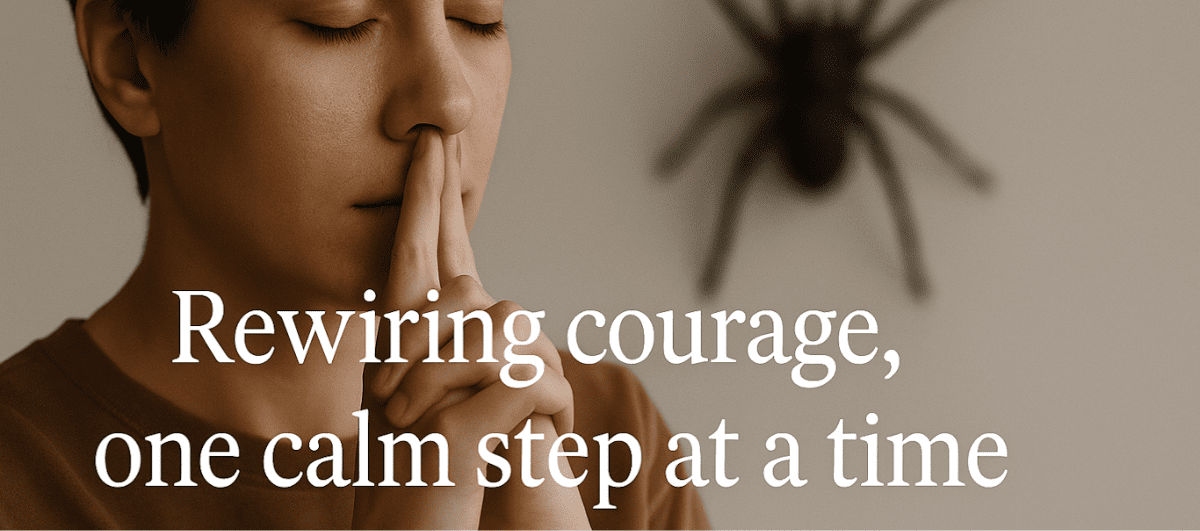
In 1958, psychiatrist Joseph Wolpe quietly changed how we understand fear. While others focused on avoiding what frightened people, Wolpe suggested the opposite: walk toward it, gently. One calm breath, one small step, one rewired association at a time.
He called it Systematic Desensitisation, and it remains one of the most quietly radical ideas in psychology: that the nervous system can be retrained through structure, repetition, and safety—not willpower or punishment.
What is Systematic Desensitisation?
At its heart, it’s a behavioural method that helps the brain unlearn its reflexive fear response. You start by pairing relaxation—deep breathing, muscle release, even slow blinking—with a small amount of anxiety. Then, as comfort grows, you increase the challenge. The aim isn’t bravery in the Hollywood sense. It’s nervous-system literacy: teaching your body that it can stay calm even when the old alarm bells start ringing.
Anxiety is learned. So it can be unlearned.
The three core steps
1. Relaxation training
Before facing any fear, you learn to create a physiological calm—slow breathing, grounding, maybe a little mindfulness. You’re building an emotional safety net before stepping into the storm.
2. The Fear hierarchy
You and your therapist map out the ladder of fear, from least to most terrifying. If you’re afraid of dogs, the first rung might be looking at a picture. Later, it’s standing near one. Eventually, it’s a pat on the head without the pulse spike.
3. Gradual exposure
You climb, step by step, pairing each exposure with calm. The brain learns: “Oh, I can survive this. I don’t need the sirens.” Fear fades. Confidence takes its place.
Courage isn’t a lightning bolt. It’s the quiet accumulation of small moments where fear expected panic and met peace instead.
Why it still works
Because Wolpe’s insight wasn’t about psychology alone—it was about biology.
You’re not reasoning your way out of anxiety; you’re reconditioning the body itself. And the body is patient but programmable. Each calm exposure overwrites the alarm signal with something new: familiarity.
It’s gentle. It’s structured. And unlike the dopamine-fuelled shortcuts of modern “self-help,” it’s slow enough for the nervous system to actually believe you.
The neurodivergent twist
For neurodivergent minds—especially those of us with AuDHD (Autism + ADHD)—Wolpe’s method holds a hidden paradox. Our nervous systems are hypersensitive and under-regulated all at once. We crave predictability but bristle at monotony. Exposure therapy, done badly, can feel like sensory assault. Done well, it can teach the body that uncertainty doesn’t always mean danger.
Where typical therapy might say “face your fear,” AuDHD therapy says, “prepare your body first, then face your fear at your own pace.” Because overstimulation isn’t cowardice. It’s neurology.
And the real desensitisation isn’t to the fear itself—it’s to the shame of feeling afraid in the first place.
The contrarian truth
Avoidance looks safe. It’s not. It’s a slow suffocation disguised as self-protection.
Wolpe’s method reminds us that comfort isn’t the goal—capacity is. The world doesn’t get smaller because we’re broken; it gets smaller when we stop walking toward what matters.
Systematic Desensitisation endures because it mirrors real courage: not the sudden triumph of fearlessness, but the steady re-training of a nervous system that has finally learned to trust itself.