

Somebody told me how it ends
Nine weeks, a Customs officer’s signature, and a classification that has not moved an inch

It arrived. I promised I would tell you how it ended, and it ended with three people who have names, one of whom got an approval in forty-eight hours after nine weeks of nobody answering.
The contrarian bit: this is not a story about persistence paying off. What I was given was an exception, not a decision. The classification that caused all of it is exactly where it was in May, and the next photographer who orders one of these walks into the identical wall with none of my advantages.
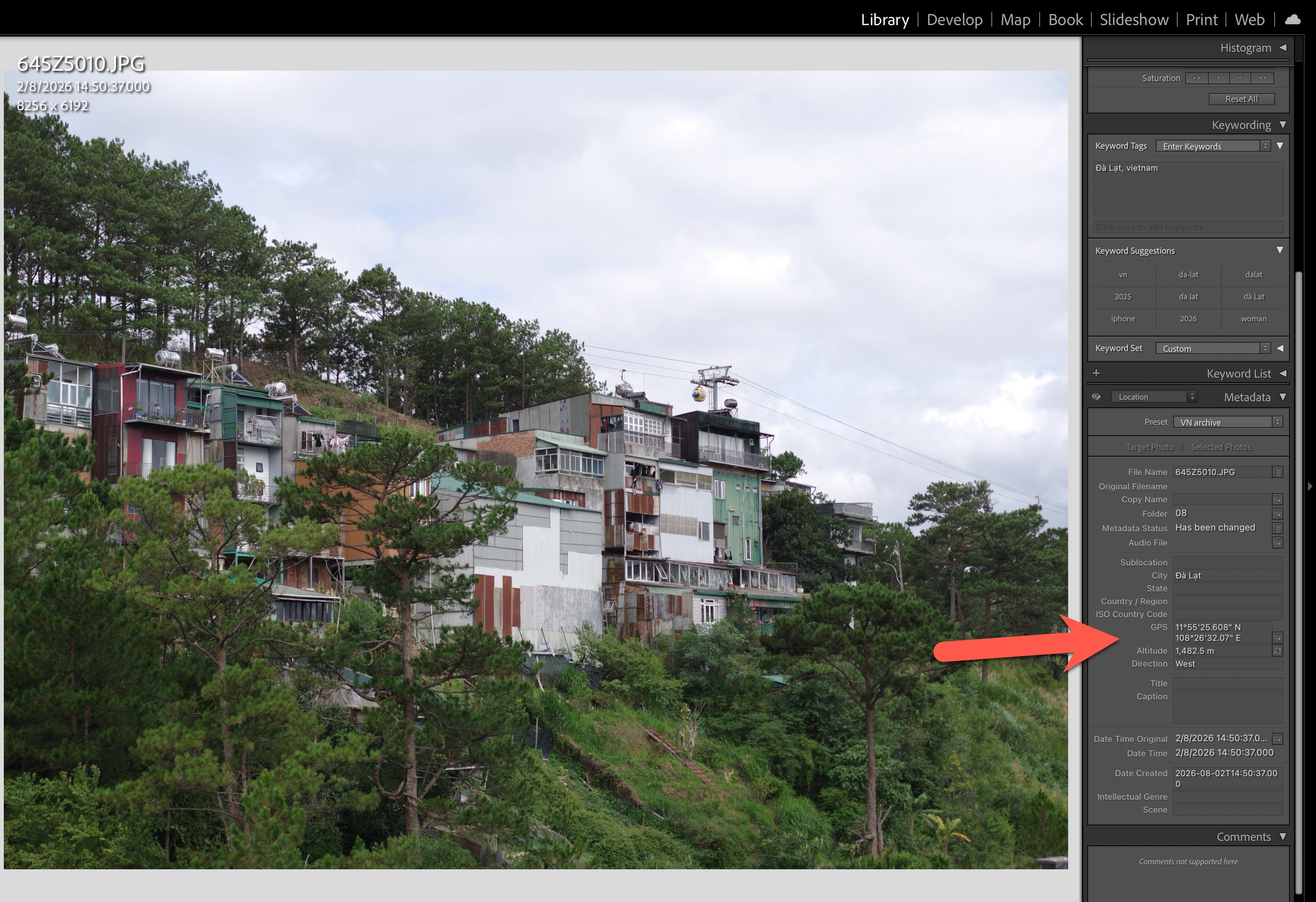
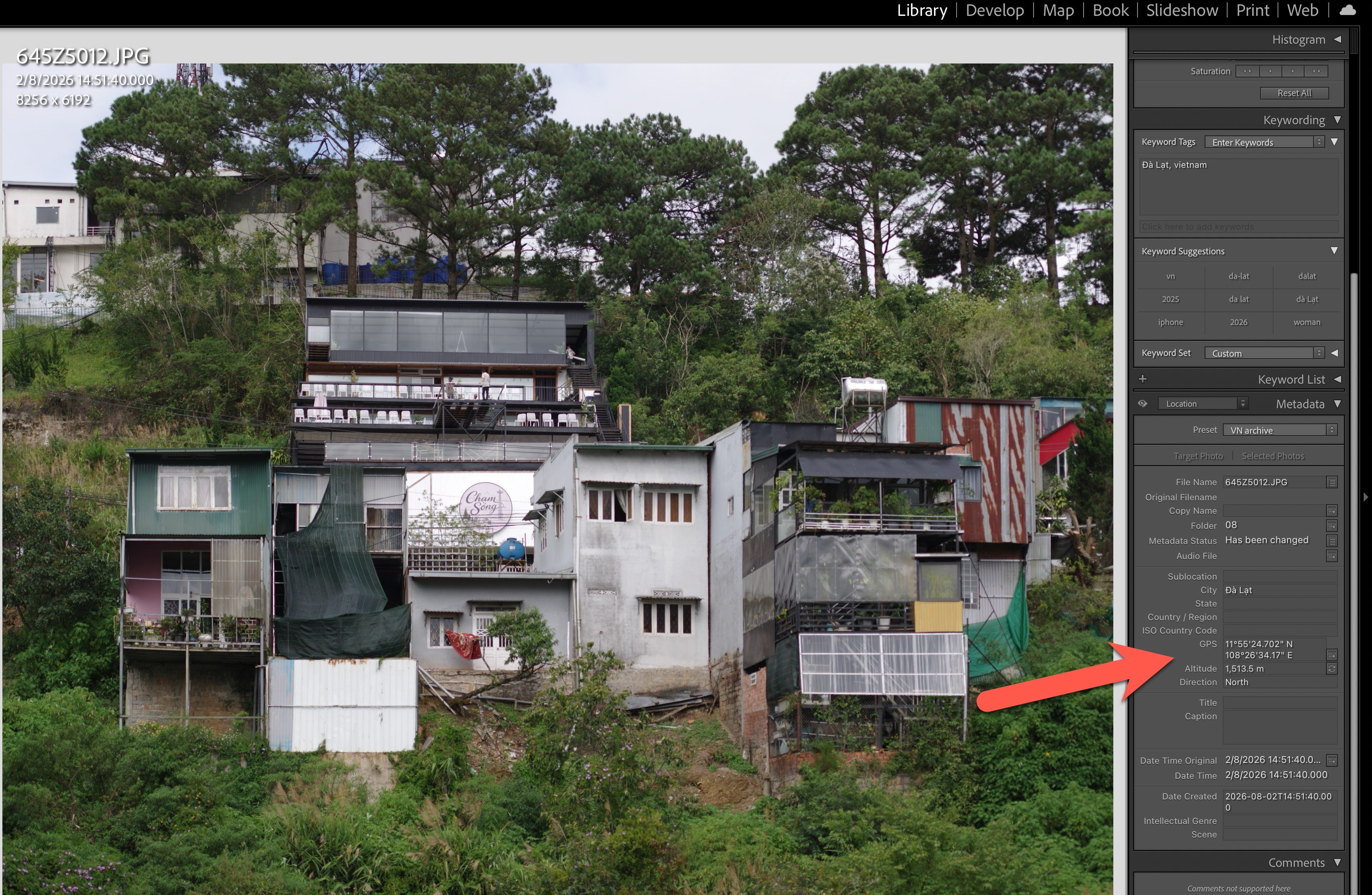
The guard at the gate of Osaka Village has been taking in my parcels for a year and has never once needed to know what is in any of them. That is the whole job, performed faultlessly, by a man on a plastic chair.
Eighty grams or thereabouts. A small screen, and a shoe that slides into the top of the camera. It wants a few minutes of open sky before it will commit to a first fix, which in Đà Lạt in August is less a technical requirement than an ongoing negotiation. Then it settles. It knows where it is standing, it knows which way the camera is looking, and it writes both of those into every frame afterwards without ever being asked again.
The two photographs above are the first it geotagged.
A few days ago I finished an article on one of my blogs by saying I did not have an ending, and that I would tell you how it ended when somebody told me. Somebody told me. Three somebodies, as it turns out, and having spent fifteen hundred words observing that nobody at that company owned the problem, it would be shabby of me to go quiet now that three people did.
The three who answered
Kinh Nguyen is a clearance agent in Ho Chi Minh City, and for nine weeks he was the only person at FedEx who replied to me at all. He went back to Customs on my behalf more than once. He sent them my website and photographs of the product, which was not in any procedure and which nobody asked him to do. And near the end, in a thread copied to his own managers, he wrote to say that he should have communicated some things more clearly and that he was sorry. He did it in English, which is not his first language, in front of the people who write his reviews. I have watched men decline to apologise in their mother tongue, alone, in a kitchen. It cost him considerably more to send that email than it cost me to accept it.
Vy Tran is a Customer Experience Relationship Lead. She took the case, put her name to it, went to a Customs officer, and came back with an approval inside forty-eight hours of a standing start. Nine weeks of process had not managed what one named adult managed in two days, which is either an indictment or a recommendation depending on where you sit in the building.
Hai Yen Nguyen handled the delivery. I sent her my Zalo number and an instruction about leaving the parcel with the guard, and she wrote it back to me correctly, first time, in a message shorter than this sentence. After nine weeks in which one document acquired four different names, being understood immediately was so unfamiliar that I read her email twice looking for the catch.
The name was in the footer
Here is the part I find hardest to be gracious about, and I am going to be gracious anyway, at some cost.
I asked five times, across four weeks, for the name of somebody senior. I never got one. That silence was the load-bearing wall of the entire essay I published: nobody home, nobody owns it, nobody obliged to notice.
Vy’s name was at the bottom of every email she sent me. It was also at the bottom of the emails from her department before she picked up the case. Under the sign-off, under a notice about operational changes effective April, under a toll-free number, under an international number, under a WhatsApp number, and under a QR code. Her name and job title were the last thing in the block, arranged as though the reader would work down through the plumbing and find the person at the bottom like sediment. A name filed beneath a QR code is a name in the same sense that a message in a bottle is correspondence.
So I mentioned it to her, politely, as a postscript. Move your name up under Best Regards and put the operational notice last, and the next customer will find you first instead of ninth. She had already got my parcel released by then, so it was hardly a complaint. I simply could not let a thing be that funny without saying so out loud.
What actually got fixed
Now the part that stops this being a happy ending, and I would rather report it than sell you the warm version.
What was granted was an exception. A Customs officer looked at the circumstances of this shipment, belonging to this Australian, and permitted it. That is a good and humane act by somebody with no obligation to perform it, and I am the direct beneficiary.
An exception is not a reclassification. Nobody has determined that a receive-only GPS accessory sits outside the scope of a list written for radio-transmitting mobile terminals. The classification that started this stands exactly where it stood on the twenty-sixth of May, in perfect health, entirely undisturbed by nine weeks of correspondence. The file now records that one man’s camera part was allowed through, which is the administrative equivalent of curing a single case of scurvy and leaving the oranges off the ship.
Which means the next photographer is going to walk into precisely the wall I walked into. They will be told to obtain a certificate that individual importers cannot obtain. They will comply, because compliance is the only move available. They will ask for a manager and get silence, and they will not know that the manager’s name is in the footer of the email telling them there isn’t one. And they will not have nine weeks of written record, a case number, three published articles and a stubborn streak with which to escalate, because most people have jobs.
The thing it was accused of
Consider what has to happen for this object to work.
Somewhere above us there is a constellation of satellites carrying atomic clocks, and those clocks have to be corrected continuously for the fact that time genuinely runs at a different rate up there than it does down here. Signals cross twenty thousand kilometres of nothing. A device the weight of a bar of soap listens, silently, and works out that it is standing on a hill in Lâm Đồng facing roughly north-northeast.
It cannot transmit. It has no SIM, no radio, no capacity to tell anybody anything at all. Its entire relationship with the world is one of attentive listening, which is more than can be said for most of the parties to this dispute.
It was detained for nine weeks on suspicion of talking.
Where it sits now
The unit is on the camera. The first frames have coordinates and a compass bearing written into them, so that whoever looks at these hills in eighty years will know exactly where I stood and which way I was facing when the light did that.
I got my ending. I do not think the system produced it. Three people did, working around it, one of whom apologised for a process he did not design, one of whom had authority nobody had told me existed, and one of whom simply read what I wrote and did that. What fixed this was not a mechanism. It was three humans deciding to behave like humans, which is wonderful, and which is not a system, and which is why I cannot tell you it will work for you.
I am, of course, going to send myself something else eventually. Everybody does. The parcel will go into the network and the network will do whatever the network does, and I will find out, as before, somewhat after the fact.